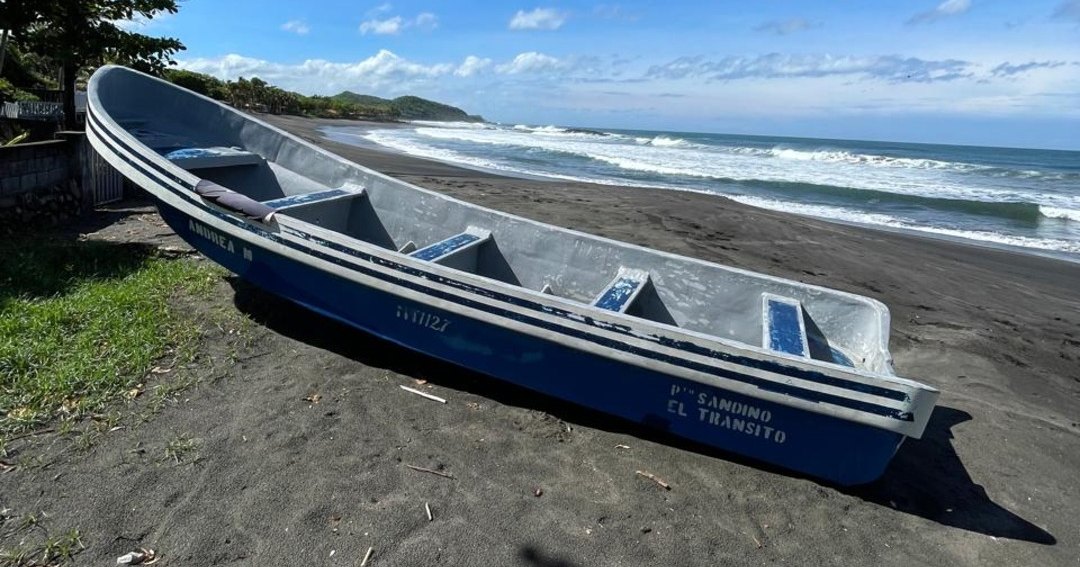
El Tránsito doesn't announce itself. There's no arrivals board, no souvenir strip, no queue for anything. You turn off the highway at KM44.5, bump along twelve kilometres of gravel through dry forest, and then the road simply ends at a curve of dark sand with a dozen blue pangas pulled up on it. That's the village — and for a certain kind of couple, that's the whole point.
A village where the boats set the clock
El Tránsito is a working fishing village on Nicaragua's Pacific coast, in the Nagarote municipality of León department, about an hour's drive from Managua. It has been a fishing village far longer than it has been a place people visit, and that order still holds. Shortly after four in the morning you'll hear the outboard motors start up in the dark; by five the pangas are sliding off the beach through the shorebreak. They come back mid-morning, and the catch is sold on the sand — snapper, corvina, whatever the morning brought.
It's a free daily spectacle, and a useful one: whatever came off the boats is what's for dinner. Or take a coffee to the north end of the beach and watch the pelicans work the same water the fishermen do.
One long beach, and the village behind it
The bay runs roughly 1.7 kilometres of dark volcanic sand, with the village sitting directly behind it — sandy streets, low houses, small kitchens, a few corner shops. Nothing is more than a few minutes' walk from the water, which changes how a day works: you don't plan an outing to the beach, you just walk out of your room.
Sunset is the moment the whole village shares. As the light goes gold, families, fishermen and travellers drift down to the sand and stand facing the Pacific until the sun drops into it. Same thing every evening, and it never gets old.
The pace is the point
There is no traffic in El Tránsito, no queue, no rush hour, and no pressure to be anywhere. Afternoons are for hammocks and cold drinks. Evenings are quiet: the bars near the beach serve a few people, and by ten the village is dark and you can hear the surf from your bed.
For couples who have spent the last few years moving fast, that's the luxury. No resort programme, no excursion desk, no need to decide anything. You swim in the morning, sleep after lunch, and read in the shade while the tide moves up and back down.
Small enough to know, alive enough to be interesting
Because it's a real community rather than a tourist strip, the village keeps textures bigger beach towns lose: a morning rhythm of boats and ice deliveries, an evening rhythm of football on the sand, a Sunday rhythm of visiting families. Small comedores cook whatever the boats brought in — fried fish, ceviche, rice and beans — at prices that make eating out every night perfectly normal.
Practical notes: it's mostly cash-only, and the nearest ATM is about 20 kilometres away, so arrive with enough córdobas (pulperías sell water, cold drinks and snacks). During Semana Santa and long national holidays the village fills up with Nicaraguan families heading for the coast — book early if your dates fall then. The rest of the year it's calm.
What a week here actually looks like
- A swim first thing, before the sand gets hot.
- Low tide at the rock pools at either end of the beach — warm, clear basins that fill twice a day.
- A walk north to Poza La Perla, a bigger natural pool in the volcanic shoreline, with a mask if you have one.
- One surf lesson or a board rental, even if you've never stood up. The waves break right out front over a forgiving, mostly sandy bottom.
- The long walk south past the boats, where the sand runs on for nearly two kilometres and you'll see more pelicans than people.
- Sunset from the sand, dinner at a beach kitchen, early night. A cold drink in the hammocks back at Casa Todo Bueno finishes the day properly.
Why couples settle in here
The quiet is what draws people, but the comfort is what makes them stay a week instead of a night. Casa Todo Bueno is a Canadian-run guesthouse that has been here since 2016, a one-minute walk to the beach but set back just enough that the evenings are still and the garden belongs to the birds. Rooms in the shared house start at US$45/night and each has its own private en-suite bathroom — the detail couples notice most after a string of shared hostel bathrooms. Air conditioning is available as an optional add-on (US$8/night) for the hottest hours of the afternoon, and the casitas give you a little more space from US$55/night.
A shared kitchen and barbecue let you cook the fish you bought on the beach, and hammocks end most afternoons. Casa Todo Bueno attracts a mix of couples, and the result is a house that's sociable when you want company and completely quiet when you don't.
Being a good guest
A few small things go a long way here. Greet people — a buenas to the neighbour, a buenos días to the fishermen — and you'll be greeted back within a day. Buy from the village shops and kitchens, learn a few Spanish words, and leave any turtle tracks on the upper beach untouched.
Come and see the pace for yourself
El Tránsito isn't a place you do; it's a place where the tide, the boats and the light set the schedule, and after two days your own clock has quietly reset to match. If that sounds like the holiday you've been trying to book for years, come and stay a while — book a room at Casa Todo Bueno: private en-suite rooms with air conditioning, one minute from the beach, from US$45/night. https://casatodobueno.com/#rooms
Planning a trip to El Tránsito? Book a room at Casa Todo Bueno — private en-suite rooms with air conditioning, one minute from the beach, from US$45/night.